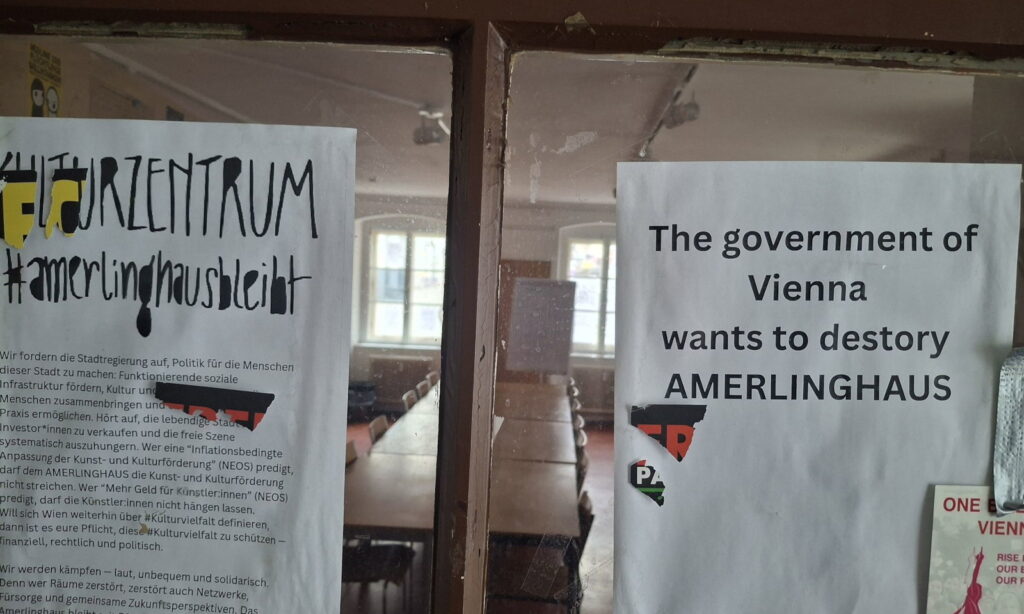
Fifty years after its first occupation, the cultural center Spittelberg in the Amerlinghaus is under threat again. Over the past months, Flora Fitzenreiter and Gabriel Rolland have been attending meetings and events, and interviewing activists, office workers, and users of the place, to understand how the budget cuts have impacted Amerlinghaus, but also how people collectively managed to resist and organize so that this space keeps existing.
*** Here you can find a german translation of this article ***
Located in the central Spittelberg district of Vienna, Amerlinghaus is an old house reaching one story height and made of old bricks. When entering through one of the arcs, one enters the inner yard of the House, which connects the two streets “Stiftgasse” and “Schrankgasse” as a pathway. In the inner yard, colorful posters of upcoming events and artworks hang on the walls. In recent times, suspended banners with slogans “Amerlinghaus bleibt” [Amerlinghaus stays] and “Krise braucht Kultur” [crisis needs culture] signal a state of mobilization.
A short history of Amerlinghaus
First occupied in the 1970s to protest the eviction of inhabitants by the municipality and the gentrification of Spittelberg, Amerlinghaus quickly turned into a self-organized center. The place progressively became central in Vienna, holding public events and providing a space for activists, artists, and social workers. Today, the Amerlinghaus hosts a variety of cultural initiatives, political groups, a self-organized kindergarten, and NGOs fighting for women’s rights, facilitating the integration of refugees and asylum seekers in Austria, and making culture more accessible to disadvantaged social groups.
Until recently, it was subsidized by the city of Vienna and included an office of permanent paid workers. But in 2025, the city of Vienna announced drastic budget cuts affecting social workers, teachers, artists, and also the cultural center. It resulted in different actions, protests, against what was denounced as neoliberal attacks against social work and the public sector. Today, carrying this legacy of 50 years of activism, the cultural center is, again, resisting.
Before the 2026 city cuts
In the 1970s, social movements, citizen demands, and occupations were on the rise in Austria. In this context, the mechanism of subsidies appeared as an efficient way for the municipality of Vienna to control and manage militant groups and squatted places perceived as subversive or dangerous. In the case of Amerlinghaus, the city of Vienna regularized the occupation and a lease agreement was signed. Overall, this political institutionalization corresponded to a mode of urban governance based on conflict avoidance, co-optation and selective in-/exclusion. On the other hand, accepting it was beneficial for activists in two ways. First, it ensured more stability by avoiding the risk of direct eviction. Second, by granting them relative autonomy, the subsidies enabled activists to determine and politice how care work would be organised.
On a calm afternoon in February 2026, we met at Amerlinghaus with Emma* for an interview. She was a former worker at the cultural center and has been an activist against racism for decades. A bit nostalgic, she remembered how “it was not so hard to get money from the city government for projects [until the late 1990s]”. She said that they could manage to do so much more back then. She also told us how the situation progressively got worse for them. As early as 2004, activists were forced to make staff cuts and savings. In 2009, financial problems that had been announced for some time became virulent.
The absence of indexation on inflation, less directly visible but in fact very concrete, progressively made it harder for Amerlinghaus workers. While fixed costs were rising, the conditions became more bureaucratic. Whereas in the 1970s the municipality would allow some relative autonomy to spaces such as Amerlinghaus, the tendency would be toward more direct control over the projects organized by activists. The municipality of Vienna was increasingly willing to set the rules. Hence, activists were pressured to set up projects in accordance with what the city expected.
Amerlinghaus is under threat
Overall, a neoliberal orientation toward budget austerity, economic rentability, and bureaucratic control was rising within the Viennese mode of governance. The 2026 budget cuts highlight an intensification of this neoliberal logic of governance in Vienna. First of all, they impact many sectors considered “unprofitable” such as culture, yet essential to many people. Moreover, the limitation of public subsidies for social and cultural activities functions as a way to regain control over how they are provided, such as in the Amerlinghaus case. The cuts also pave the way for privatization by compromising the quality of public services. Lastly, given their scale, the cuts simultaneously affect Amerlinghaus and several social sectors, signaling an intensification of austerity measures in Vienna.
In Amerlinghaus, activists face growing financial difficulties and cannot employ workers anymore. Some NGOs are directly affected by the cuts as well as indirectly affected if the Amerlinghaus had to close. Indeed, by providing rooms for free, easily bookable and accessible to Viennese inhabitants, the Amerlinghaus greatly facilitates the work of NGOs. Thus, the “Vereinigung für Frauenintegration” [Women’s integration association] currently uses the house in the morning to help women obtain German language certificates, which are required to work in Austria. We conducted an interview with two workers from the NGO. They shared with us how Amerlinghaus‘ closure would concretely impact their activity: „If we lose these rooms now, we won’t know where to go. So we’d have to apply for more funding so that we can rent other premises, but given the current austerity measures, nobody’s going to give us that much more funding. […] So, it’s an extremely precarious situation, an extremely stressful situation for us” (Clara, NGO worker at Amerlinghaus).
Overall, social workers and activists feel that the work they provide is no longer valued and recognized by the City of Vienna. There is a shift in the extent of municipal support in Vienna for certain activities of social reproduction, understood as the process through which labor power and, more broadly, human life is reproduced in a given society. As Cindy Katz, scholar and political theorist argues, social reproduction happens “both generationally and on a daily basis, through the acquisition and distribution of the means of existence, including food, shelter, clothing, and health care”.
This can take on multiple forms. For example, language courses or healthcare can be provided for free and funded by the State or be mediated by the market and directly cost money for individuals; that is, being commodified. For NEOS‘ and SPÖ’s members, part of the current ruling coalition in Vienna, the cuts are justified by the need to reduce spending. Yet for activists and NGO workers, whether an activity is funded or not is ultimately a political choice about what activities should be accessible and valued or not. Precisely for this reason, activists decided to mobilize.
Rethinking mobilization
Different protests occurred last December and in January to oppose the cuts. Activists also attempted to enter the city council to have a direct talk with officials. In Amerlinghaus’s case, although there was no threat of eviction, activists were mobilising to find new ways to secure long-term funding. A lot of solidarity events took place, bringing dozens of people together and contributing to the fundraising. Yet the mobilization was also crossed with doubts that some activists shared with us, pointing to what they identified as limits to overcome. Meeting with a Turkish activist living in Austria, she shares with us that she feels like a „us-them“ distinction has formed: It seems to me that they [Amerlinghaus workers] couldn’t create a sense of „If we’re finished, you’re finished, but instead said „come on citizens, we’re in a very bad situation.„” (Emre, user of Amerlinghaus and activist)
Despite low barriers in accessing Amerlinghaus’ space and events, it seems that this alone cannot generate the shared sense of stakes that collective resistance requires. On the other hand, this is probably a consequence professionalization and task specialization entail. A consequence that could not be overcome spontaneously without conscious efforts to organize with people and not only call them to mobilize.
And this takes time, as Emma observes : “I’m thinking that this idea, you know, city government financing Amerlinghaus, is over… So, it’s like, it’s this wave of killing social rights, social Vienna. It’s the end of it. It’s not only the end of Amerlinghaus […]. What is good is that a lot of people are coming, a lot of people are concerned, a lot of people are putting their ideas into it. They are discussing: what can we do? Can we make fun of fundraising? Can we run the house without employees? It’s a process. […] I think there is another generation. Maybe they have other ideas, maybe they have other political concepts, maybe they are motivated or engaged enough to find something” (Emma, former Amerlinghaus worker).
Finding new ways
If today Amerlinghaus exists, the future is precarious. Although the city is still funding the rent for the building until the end of the year, nobody knows what will happen when this stops. The budget cuts already forced the cultural center to become fully self-organized without permanent workers. The necessary tasks former workers were ensuring are now done for free by activists and users, turning paid into unpaid labor, which is a setback. On the other hand, maybe complete self-organization will open new paths for resistance and social mobilization. For all these reasons, Amerlinghaus still needs financial and human support from us to keep the place running and to oppose budget cuts more broadly.
*all names in the article have been changed
Picture: Gabriel Rolland